




Beam-search feature construction with false-discovery-rate (FDR) controlled selection, packaged as scikit-learn estimators.
beamfeat builds interpretable mathematical expressions from your columns —
(x0 / x2) * x1, log(a) * log(b) — searches for the ones that explain the
target, and then screens them with a selection procedure whose statistical
guarantee is stated, tested, and honestly reported when it cannot be given.
from beamfeat import BeamFeatRegressor

model = BeamFeatRegressor(max_depth=2, beam_width=30).fit(X, y)

model.formulas()        # ['((x0 / x2) * x1)', ...]
model.equation()        # 'y = 0.9847*((x0 / x2) * x1) + ...'
model.fdr_controlled_   # True: the features carry the stated FDR guarantee
model.predict(X_new)pip install beamfeat # core: numpy + scikit-learn only
pip install "beamfeat[units]" # + pint, for unit-aware search (units as
# strings like "kg" or as pint quantities)
pip install "beamfeat[all]" # + sympy display support and test depsPython ≥ 3.10. There are no upper version pins: the 370 tests pass from
scikit-learn 1.6.1 with numpy 1.26 through scikit-learn 1.9.0 with numpy 2.4,
including 1.7.2 and 1.8.0 in between. Running the test suite or reproducing
the benchmarks needs a little more setup, described in
docs/installation.md.
- Search. A beam search over an expression DAG proposes and scores
compositions of unary (
log,sqrt,reciprocal,square,abs) and binary (*,/,+,-) operators, with structural deduplication, redundancy pruning, and cost O(depth × beam²) rather than the exhaustive O(operators^depth). - Selection. Candidates are tested for association with the target under procedures that control the false discovery rate (details below), on a held-out split of the training rows that the search never saw.
- Fit. A parsimony step (greedy forward selection within the screened
set, on by default) keeps the compact subset the equation uses — the full
screened set with per-candidate p- and q-values stays auditable in
selection_report_— then a linear model fits it, readable via.equation().
Numerical failures (overflow, domain errors) are recorded and excluded, never
silently masked. Optional unit propagation — units given as pint quantities
or as plain strings like "kg" or "m / s**2" — rejects dimensionally
invalid expressions at construction time. On a kg/m/s mechanics example this
cuts the number of candidates ever evaluated by roughly two-thirds before any
data work; the exact fraction depends on how many distinct dimensions the
columns carry.
- Permutation selector (default). Tests marginal association with an exact permutation test: the statistic (|Pearson r| for regression, eta-squared for classification) is a fixed function of the data, and p-values use the add-one estimator of Phipson & Smyth (2010). Multiplicity is corrected with Benjamini–Yekutieli by default (valid under arbitrary dependence); Benjamini–Hochberg is available and is valid under positive dependence (PRDS).
- Knockoff selector. Fixed-X knockoffs (Barber & Candès, 2015) when
n ≥ 2p: no distributional assumption on the features — engineered columns are fine — with the guarantee requiring Gaussian noise in the linear model. Model-X Gaussian knockoffs (Candès et al., 2018) only as ann < 2pfallback, with a warning, since engineered features violate its Gaussianity assumption. - Selective inference. Search retains candidates because they correlate
with the target in its sample, so testing them on the same rows would bias
p-values optimistically. By default the estimators search on one half of
the training rows and select on the other (
selection_holdout=0.5). - Association ≠ generalisation. A post-fit check on the selection
holdout raises a visible
DegenerateFitWarningif the assembled model fails to generalise (negative held-out R², or accuracy below the majority class) — FDR certifies the features' association, and this check covers the separate claim that the equation built on them is sound. - Honest failure. If nothing passes selection, the default
(
on_no_discoveries="empty") keeps no constructed features: the model degrades to an intercept-only fit and raises a visibleNoDiscoveriesWarning."fallback"(keep the unfiltered search output, flaggedfdr_controlled_ = False) and"raise"are available. It never silently claims a guarantee it does not have.
Three readings of these guarantees matter. FDR is an expectation over repetitions, not a per-run bound. The marginal null counts a near-duplicate of a real signal as a true discovery — de-duplication is the redundancy threshold's job, not the error-control procedure's. And every number below carries Monte Carlo error from finite trials.
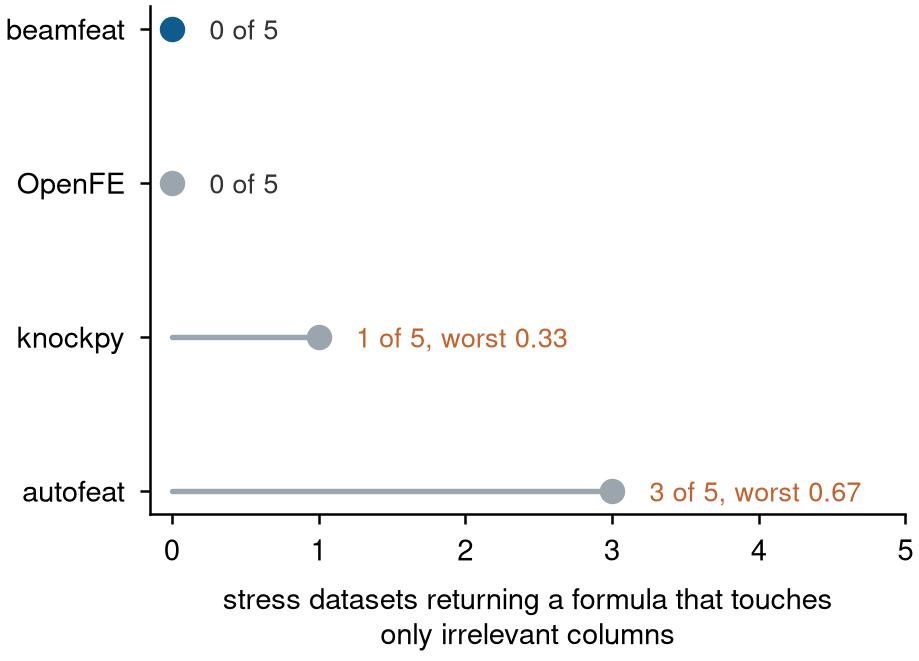
Signal hidden among ten distractor columns. A false feature is a returned
formula touching only irrelevant ones; the count is over the five stress
datasets that declare which columns their formula uses. Regenerate with
python benchmarks/make_figures.py, which writes six other figures alongside
it.
All of the following are measured by the test suite or the committed benchmark scripts, not asserted:
- Selector calibration (Gaussian designs, 100 trials,
benchmarks/selector_calibration.py): BH realised 0.046 ± 0.008, 0.084 ± 0.012 and 0.161 ± 0.016 at nominal 0.05/0.10/0.20, against its ceiling ofq·m₀/m= 0.040/0.080/0.160; BY, stricter by a harmonic factor, realised 0.008 ± 0.004, 0.018 ± 0.005 and 0.046 ± 0.008. Power 1.00 throughout. The bounds are computed from the design and the script fails if a realised rate sits above one. - End-to-end pipeline (search + holdout selection) at nominal FDR 0.10: no false discovery in 200 replicates, a 95% upper bound of 0.015 on the true rate, power 1.000, zero fallbacks; zero selections over 60 global-null replicates.
- Feynman-equation panel (12 physics laws, 0.1% noise): 10/12 solved at the SRBench criterion and 8/12 in exact symbolic form, ~0.6 s per equation; the misses are named boundaries (a depth-3 rational, a literal constant, depth-4 nesting, the Gaussian's exponential).
- Pure-noise stress (
benchmarks/selector_calibration.py): over 100 global-null pipelines, where every selection is false by construction, BH returned features in 6 trials and BY in 1 — false discovery proportions of 0.06 and 0.01, both under the nominal 0.10. The gap is not significant at this trial count (p = 0.12); BY is the estimator default because it is valid under arbitrary dependence, and this is the consistency check. - Stress suite (signal among ten distractor columns): beamfeat's false-feature rate — returned formulas touching only irrelevant columns — is 0.000 at noise levels from 5% to 50% of the signal scale and at n as small as 120, with recovery and the guarantee intact throughout; autofeat recovers the formula equally often but returns distractor-only features on 3 of the 5 scoreable datasets. Reported as a count rather than a mean: with five datasets the mean carries a standard error of about 0.15, and autofeat's output varies between processes in any case.
- Real data (seven datasets, numeric columns): best on mpg (0.871 vs LightGBM 0.853) and tips — where gradient boosting overfits below ridge while the FDR gate holds beamfeat at the ceiling — tied with ridge on diamonds from one interpretable feature, behind LightGBM on penguins and breast cancer, and behind ridge on diabetes (0.376): no nonlinear structure exists there to find, and beamfeat does not invent any.
- OpenFE on the same stress suite (its features + LightGBM, after shimming a removed sklearn parameter): false-feature rate also 0.000, but 0/5 formulas recovered and lower R² throughout — it optimises tree-model lift, not equations.
- Heavy-tailed noise (Student t(2), infinite variance): exact formula recovered at R² 0.956 vs LightGBM 0.866 — the permutation test is distribution-free, so heavy tails cost it nothing.
- Known boundaries, measured: on piecewise targets trees win outright (LightGBM 0.998 vs 0.808 — if a tree model beats beamfeat by a wide margin, the signal is likely piecewise, not algebraic; OpenFE records 0.998 there too, but bit-identically to raw LightGBM and from a feature touching only an irrelevant column, so the credit is its tree consumer's), and on Friedman #1 the shortfall splits, over six draws, into a representation oracle of 0.960 ± 0.003, a screening-admissible ceiling of 0.874 ± 0.006 (the marginally-quiet quadratic is priced by the guarantee itself) and an achieved 0.776 ± 0.013: about 0.086 lost to what marginal screening cannot see, 0.098 to the search — stated rather than hidden.
- Test suite: 370 tests at 95% statement coverage (a 90% floor is enforced in CI), including scikit-learn's full estimator-conformance checks.
- Selection-only baseline (knockpy on raw columns, modified-FDR offset — the only satisfiable configuration at these dimensionalities): 0/15 formulas recovered, core-suite R² at the ridge level (0.845), and distractor-only features on 1 of the 5 scoreable stress datasets — the construction step and the holdout are the delta.
- Independent 360-fit study across nine datasets and eight methods
(
benchmarks/independent/): mean R² 0.803 against random forest 0.810, LightGBM 0.798, OpenFE 0.736, ridge 0.704, autofeat −1.561 and featuretools −2.478 — and a worst single fit of 0.355, none below zero, where autofeat reached −103.2 and featuretools −57.3, at ~60× autofeat's speed, with the FDR flag delivered on 45/45 fits. - Benchmarks (70/30 splits): mean R² over the ten core-suite problems, and recovery of the generating columns over the ten synthetic problems that declare them — the two sets differ by one dataset each. beamfeat mean R² 0.9989, ~0.2 s fits, 10/10 recovered; autofeat 0.9968, ~12 s, 8/10; LightGBM 0.9798; ridge 0.8442. On the purely linear problem — where feature construction should not win — ridge ties beamfeat.
beamfeat's design began from a code review of autofeat (Horn et al., 2019) and keeps its best idea — compact symbolic features feeding a linear model — while replacing exhaustive expansion with beam search, heuristic noise-threshold selection with FDR-controlled procedures, and upper-pinned dependencies with tested floors. The generate-then-FDR-filter design has a direct precedent in tsfresh (Christ et al., 2018), which filters mass-generated time-series features under Benjamini–Yekutieli control; beamfeat applies that design to symbolic expressions on tabular columns.
benchmarks/independent/ holds a 360-fit study (nine datasets, eight
methods, five splits, average ranks plus a Friedman test) with its harness,
pinned environment, data, and a notebook that reproduces the analysis. Mean
held-out R²: beamfeat 0.803, random forest 0.810, LightGBM 0.798, OpenFE
0.736, ridge 0.704, autofeat −1.561, featuretools −2.478 — and worst single
fit of 45: beamfeat 0.355, autofeat −103.2, featuretools −57.3, with the FDR
guarantee delivered on 45/45. Read PROVENANCE.md first: it records what is
reproducible (beamfeat, bit-identically) and what is not (autofeat seeds
no random_state and drawing its decoy features from the global NumPy
generator, swung from +0.952 to −109.8 across six runs on one identical split).
Tutorial notebooks live in notebooks/ (getting started; search and scoring;
selection and units). The statistical guarantees are documented in detail in
docs/guarantees.md and in the module docstrings of beamfeat.selection. Users coming
from autofeat will find a full API mapping and version-compatibility notes
in docs/migrating-from-autofeat.md.
See CITATION.cff. If you use the selection procedures, please also cite the
underlying statistics: Benjamini & Hochberg (1995), Benjamini & Yekutieli
(2001), Barber & Candès (2015), Candès et al. (2018), and Phipson & Smyth
(2010).
MIT.