Define a creative style once on StyleRef — colors, lighting, mood, composition, guardrails — then load it as a node and reuse it across your workflows.
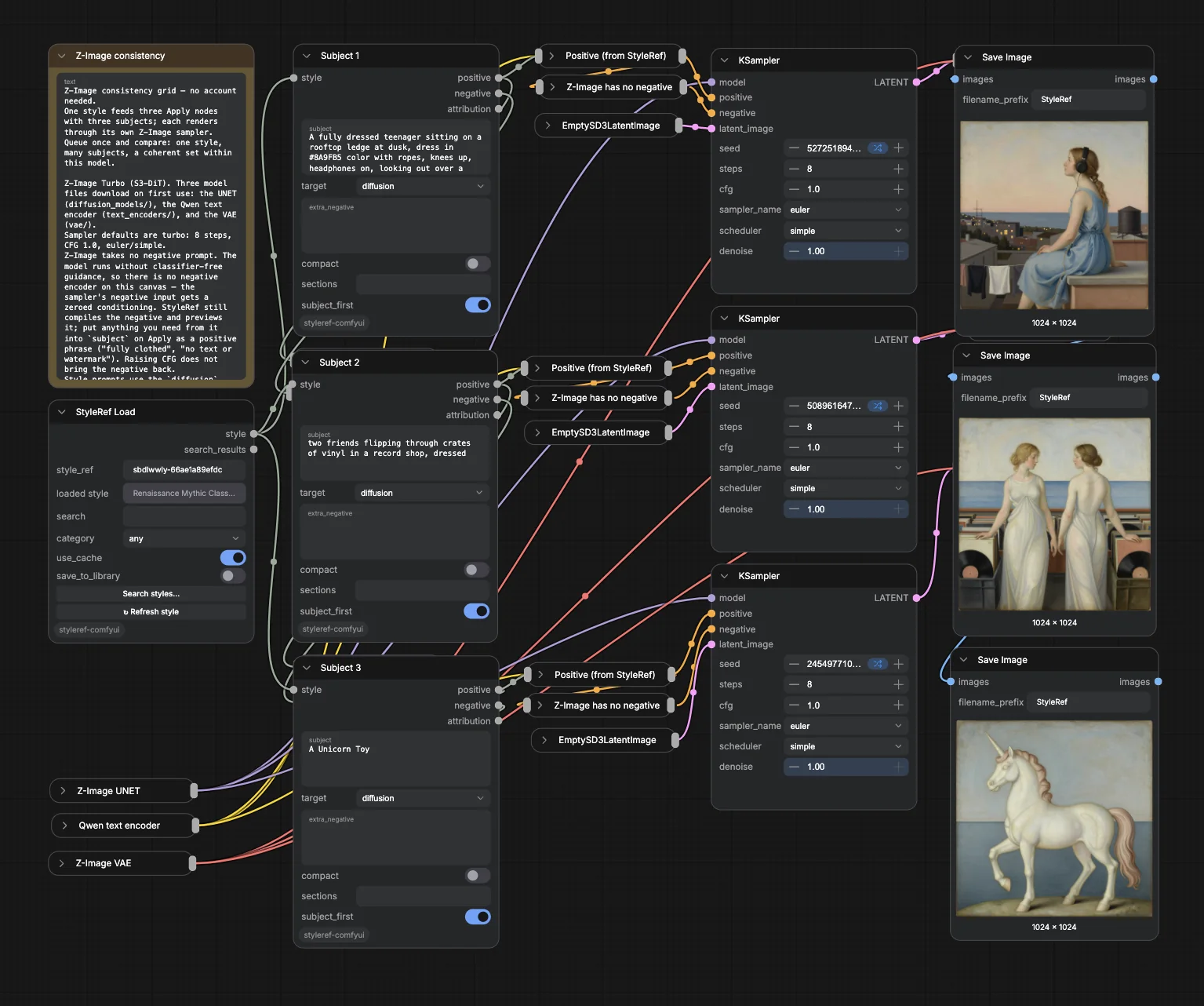
One StyleRef Load feeding three Apply nodes with three unrelated subjects — a rooftop at dusk, a record shop, a toy unicorn. The style holds; only the subject changes. That is the whole idea.
The style is compiled server-side for whichever model you point it at, so the same style produces prompt text phrased appropriately for each one.
No account needed to load and apply public gallery styles. An account adds your own private styles. Nothing in this node pack spends credits.
ComfyUI Manager (recommended) — search for StyleRef and click Install.
Manually:
cd ComfyUI/custom_nodes
git clone https://github.com/StyleRef/styleref-comfyui
Restart ComfyUI. Nothing to install: the pack declares no Python dependencies
and imports on the standard library alone. The Reference Images node reaches
for Pillow and numpy when it runs, and every ComfyUI install already ships
those. Look for [StyleRef] v1.0.6 — 5 nodes registered in the server console
at startup.
It does depend on styleref.io. These nodes are a client, not a local
library: every style is fetched from the StyleRef API at
https://styleref.io/api/v1, and all prompt compilation happens there. So the
pack needs a working internet connection and the service to be up — offline, or
during an outage, the nodes fail with an error rather than degrading. Loaded
styles are cached for the session, so a graph mid-run keeps working, but the
first load of any style is a network call. STYLEREF_API repoints the client
if you run your own instance.
Two hosts, then, and no others: the API above, and — only when the Reference Images node runs — the storage host serving that style's inspiration images. Those image requests are deliberately anonymous: your token is never sent to a host outside the API. Nothing here spends credits.
- Add StyleRef Load and paste a slug from the
gallery into
style_ref(tryazch4ptx-2ca7d3a07f37, the Raw Theatrical Cinematic style) — or click Search styles… to pick one. - Add StyleRef Apply, connect
style, type a subject, pick your target. - Wire
positive/negativeinto your CLIP Text Encode nodes.
Or drag workflows/01-quickstart.json onto the
canvas.
| Node | Sign-in | What it does |
|---|---|---|
| StyleRef Load | No | Fetch a style by share slug or share URL — and, signed in, your own private styles by id or /styles/{id} URL. Names the loaded style on the node, plus gallery search with a picker dialog and a ↻ Refresh button. |
| StyleRef Apply | No | Compose a subject with a style into positive / negative prompts for a chosen target, with a prompt preview in the node body. |
| StyleRef Facets | No | Every schema section as its own output — exactly the style board's section list, plus the six custom style items. |
| StyleRef Reference Images | No | The style's inspiration images as an IMAGE batch — for IPAdapter and reference conditioning. |
| StyleRef Login | — | Status line + Sign in / Sign out buttons. Needed only to load your own private styles. |
ai_tools, style_md, flux, midjourney, diffusion, json — exactly the
web app's copy-box format list. For the sampler in your graph use flux (FLUX
models) or diffusion (SDXL, SD1.5, DALL·E-class); the other four are for
copying the output out of ComfyUI, and the node warns if one feeds a CLIP
encoder.
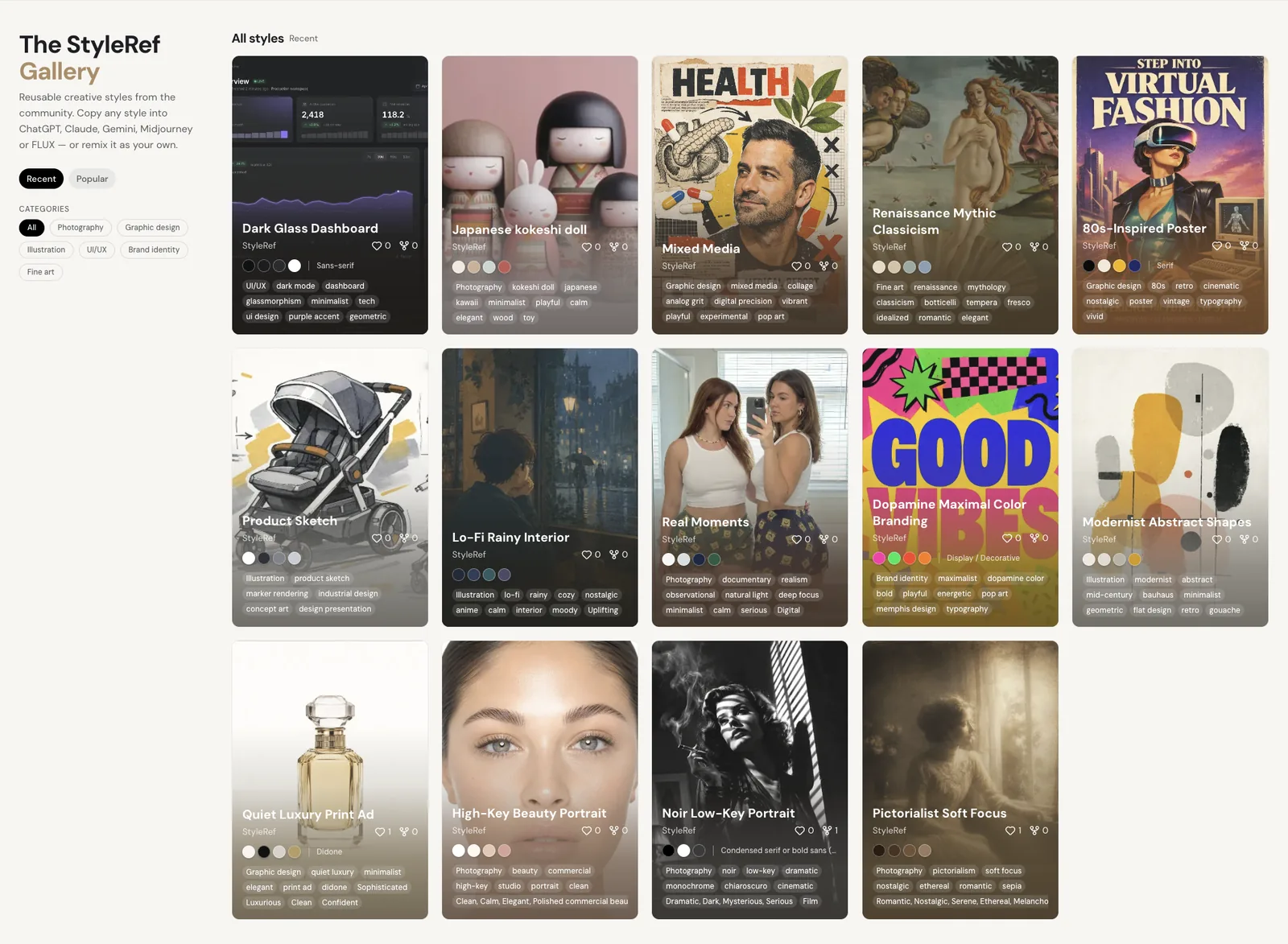
Every style on styleref.io/gallery loads here by its slug — no account needed.
Extraction (turning an image into a style) happens on styleref.io — upload an image there, refine the result, and it lands in your library. Load it here by its share slug or id (sign in with the Login node first).
The templates at the root run on FLUX.1 dev (the Comfy-Org fp8 all-in-one checkpoint, downloaded on first queue). FLUX reads the prompt with T5, so a full compiled style fits — an SDXL CLIP encoder truncates it at ~77 tokens, which is why the style washes out there no matter which checkpoint you use.
| File | Sign-in | Story |
|---|---|---|
01-quickstart.json |
No | Load → Apply → generate |
02-consistency-grid.json |
No | One style, three subjects, side by side |
03-your-own-style.json |
Yes | Extract on the web, load your own style here |
04-reference-images.json |
No | The style's inspiration images as a batch, next to a render |
05-facets.json |
No | Every section of the style as its own output, next to a normal render |
A parallel set wired for Z-Image Turbo (an S3-DiT model — UNET + Qwen text
encoder + VAE, compiled from the diffusion target) lives in
workflows/z-image/: the same five stories on that
loader stack. The three model files download on first run.
The two sets load different gallery styles on purpose. How well a style demos is a property of the style and the model. FLUX is strongest at light and colour rather than brushwork, so its templates load a theatrical cinematic style — hard cast shadows, a saturated key, staged props. Z-Image reproduces painterly technique faithfully, so its templates load a Renaissance tempera style. Swap either for any slug from the gallery; these are starting points, not limits.
Every template is built to read at a glance on open: the on-canvas notes say what the template produces and where the model comes from, and the plumbing between Apply and the sampler (the text encoder, the zeroed conditioning, VAE Decode) ships collapsed — nothing in there is yours to edit. Expand any of them if you want to rewire.
Neither FLUX nor Z-Image takes a negative prompt. Both are guidance
distilled and run at CFG 1.0, where the negative branch is multiplied out
entirely — so neither set carries a negative encoder, and the sampler's
negative input gets a zeroed conditioning. StyleRef still compiles the negative
and returns it on Apply's negative output; fold anything you need from it into
subject on Apply as a positive phrase. Raising CFG does not bring it back.
Apply prints the prompt it composed, and its token estimate, in its own node body after a queue — that is where to read what StyleRef actually sent the sampler.
FLUX has a confident house look and drifts back to it. Two dials, in the order worth trying:
Flux guidance(3.5 in the templates, FLUX's default) is the blunt one. 4–5 makes the style bite harder; past that the subject starts losing to it, colour goes poster-flat, and a dark style can go to pure black.- Narrow
sectionson StyleRef Apply to the parts that define this style. For a period or painterly style that is usuallyartistic_mediums,references,surface_material,colors— the sections naming the medium, the era and the finish. Left empty, every section is sent, and the identity-carrying ones render last, so a long style can read as generic. For a geometric or layout-led style keepshape_languageandspatial_hierarchyinstead. Queue the Facets template to see what a style actually carries.
Sampler defaults, for reference: FLUX 20 steps, Z-Image Turbo 8, both at CFG 1.0 with euler/simple, seeds randomizing on every queue.
Add the StyleRef Login node and click Sign in (browser) — no queueing
needed. Your browser opens, you approve, and the node's status flips to signed
in. The token is stored at ~/.config/styleref/credentials.json with 0600
permissions. The styleref CLI
shares this login.
(No frontend at all? npx styleref login signs in the same credentials file,
and queueing the Login node reports the current status.)
Browser sign-in cannot work on a rented GPU box, RunPod, or any headless
server: there is no browser to open, and localhost is the wrong machine. Use a
token instead:
- Copy a token from your account page.
- Where ComfyUI runs, set
STYLEREF_TOKEN=<token> - Restart ComfyUI.
STYLEREF_TOKEN always takes precedence over stored credentials. The Login node
detects the headless case and prints these instructions rather than hanging.
Nothing in this node pack spends credits. Loading, searching, and applying styles is free and unlimited within the public rate limit. Extraction — the one paid action — happens on styleref.io, where you can preview and refine the result before it costs anything beyond the extraction itself. See plans and limits.
| Variable | Purpose |
|---|---|
STYLEREF_TOKEN |
Bearer token; overrides stored credentials. The headless path. |
STYLEREF_API |
API base URL. Defaults to https://styleref.io/api/v1. |
STYLEREF_FORCE_BROWSER_LOGIN |
1 forces browser login, 0 forces the token path. |
pip install pytest ruff pillow numpy   # pillow/numpy are test-only deps
pytest tests/ -q
ruff check .
python scripts/build_workflows.py   # regenerate workflow templates
The workflow templates are generated — edit
scripts/build_workflows.py, not the JSON.
Shipping a change to users — a version bump, a Registry publish, updating the
monorepo pointer — is RELEASING.md.
The nodes are a thin client over StyleRef's public REST API v1 (OpenAPI). All prompt compilation happens server-side — this pack never writes style prose itself, so improvements to StyleRef's compiler reach you without an update to this pack.
MIT — see LICENSE.