


Architecture Principle: Data gravity creates financial gravity. Your baseline cost is dictated by data mass; your multipliers are dictated by routing.
This repository consolidates Rack2Cloud research on cloud egress architecture into a structured reference for architects and infrastructure teams responsible for cloud cost governance and data movement design.
Egress cost is not a billing problem. It is an architectural problem that manifests as a billing problem. The patterns in this repository address egress at the architectural layer — where data moves, why it moves, what that movement costs, and how to model those costs before they appear on an invoice.
The intended audience is cloud architects, platform engineers, and FinOps practitioners responsible for cloud networking, data movement, and cost governance.
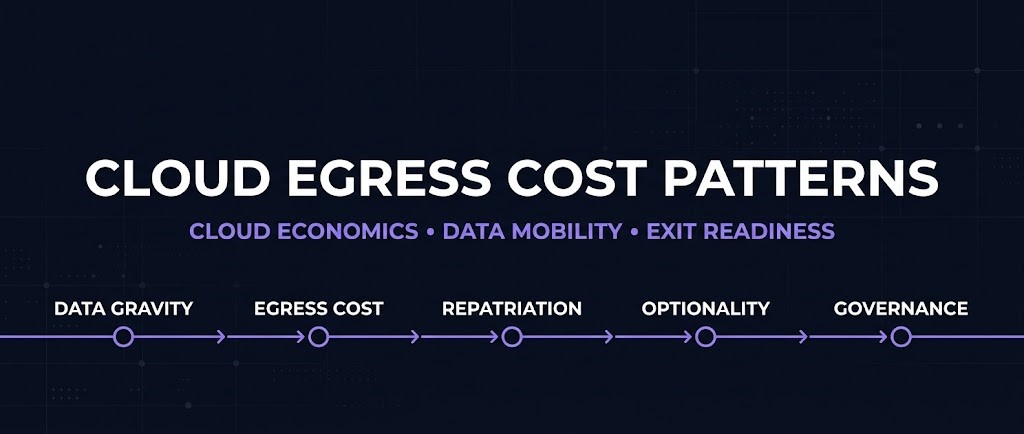
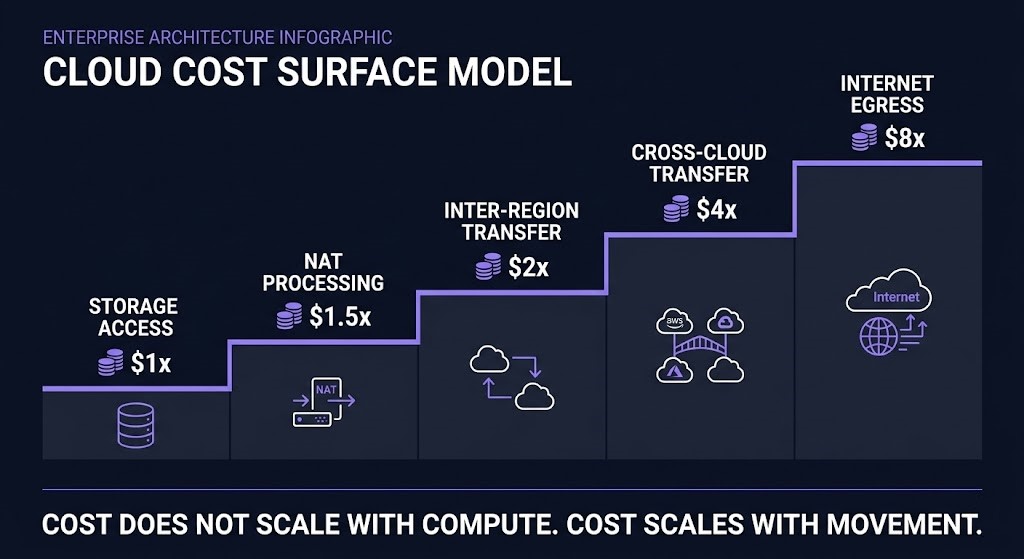
Cloud cost overruns are often attributed to compute consumption but frequently originate from data movement topology.
Architectures that route storage traffic through NAT Gateways, cross-region links, service meshes, or unnecessary inspection layers create compounded transfer costs that scale with data volume rather than workload complexity.
This repository models those cost surfaces and provides routing guidance intended to minimize unnecessary egress exposure.
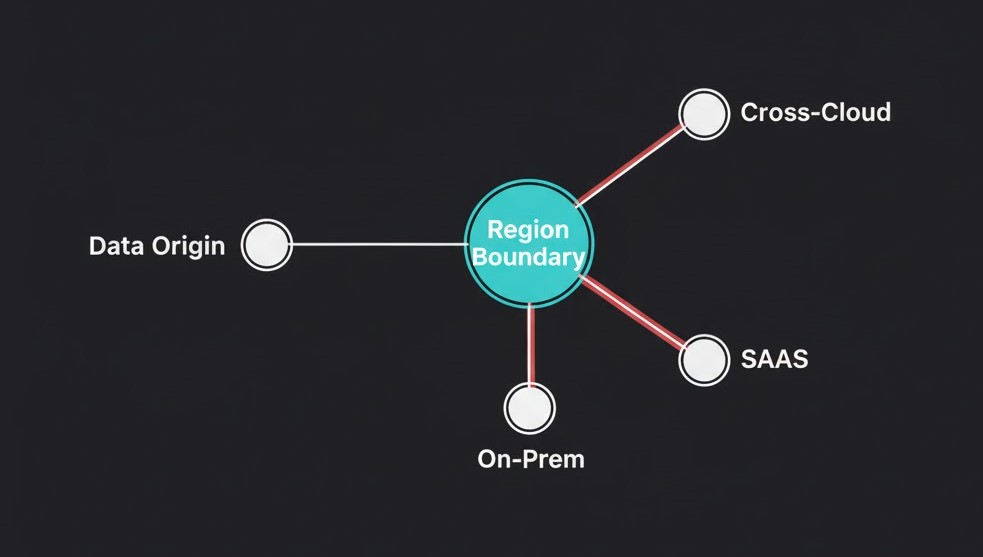
The model treats every data transfer boundary as a potential cost amplification point.
- Data origin (VPC / subnet)
- Cloud-native storage
- Cross-region transfer
- Cross-cloud transfer
- Internet egress
- SaaS consumption
- On-premises connectivity
- NAT Gateway processing
- Inter-region transfer
- Transit Gateway processing
- Cross-provider transport
- Internet egress fees
- Third-party network services
| Scenario | Recommendation |
|---|---|
| High-volume S3 traffic inside AWS | ✅ VPC Gateway Endpoint |
| Cross-account private service access | ✅ PrivateLink |
| Public internet API access | ⚠ NAT Gateway acceptable |
| Multi-region connectivity | ✅ Transit Gateway architecture |
| Hybrid connectivity | ✅ Direct Connect / ExpressRoute evaluation |
| Large-scale analytics export | ✅ Dedicated egress modeling before deployment |
Cloud egress cost is not only a cost optimization problem.
It is also an exit readiness problem.
Organizations frequently discover that data extraction costs become a major barrier during:
- Cloud repatriation projects
- VMware exit programs
- Sovereignty initiatives
- Mergers and acquisitions
- Platform consolidation efforts
The cost of moving data often determines whether an exit remains economically viable. Cloud egress charges are frequently the first place organizations discover that architectural optionality has already been lost.
The period during which an organization retains structural optionality to exit a cloud provider without architectural reconstruction.
The window is maintained through:
- Portable data architectures
- Independent control planes
- Organization-owned observability
- Identity sovereignty
- Modeled egress economics
Once the window closes, exit becomes an architectural reconstruction exercise rather than a migration project.
The foundational framing for why egress is an architectural problem, not a configuration or billing problem.
Egress as Structural Cost
- Think Like an Architect: The Field Guide to Cloud Egress and Data Gravity — The foundational egress architecture field guide.
- The Physics of Data Egress: How to Burn $180k in a Weekend — Egress cost physics and how architectural decisions produce unbounded exposure.
- Cloud Egress Costs Explained: Why Your Architecture Is Paying a Tax You Never Modeled — Egress as an unmodeled architectural tax.
Exit Cost as a First-Class Constraint
- Exit Cost as a First-Class Metric: The Architecture Constraint Nobody Models — Exit cost modeled as a first-class architectural input, not a post-deployment discovery. (Added 2026-06-30)
- Most Cloud Exit Strategies Start Too Late — Egress cost planning as a prerequisite for cloud exit decisions. (Added 2026-06-30)
Data Gravity
- The Law of Data Gravity: Why Compute Eventually Moves to the Data — Data gravity as the structural driver of egress decisions. (Added 2026-06-30)
- Vendor Lock-In Happens Through Networking — Not APIs — Networking as the primary egress lock-in vector. (Added 2026-06-30)
Specific egress patterns, failure modes, and architectural tradeoffs across cloud provider configurations.
Cross-Region and VPC Patterns
- Cross-Region Egress Patterns: S3→Internet vs VPC→VPC Traps — Pattern-level analysis of cross-region egress configurations and their cost traps.
- The Public Internet is Not an SLA: Architecting Deterministic Multi-Cloud Interconnects — Private interconnect as an egress architecture pattern.
Provider-Specific Patterns
- Azure Private Endpoint DNS Issues: Fix Recursive Loops and Prevent Subnet Exhaustion Before 2026 — Azure private endpoint configuration as an egress pattern.
- Azure Private Network Auditor — Azure private networking audit reference.
Multi-Cloud Egress
- Hybrid Cloud vs Multi-Cloud Architecture: The Engineering Reality Nobody Documents — Multi-cloud egress architecture and its engineering realities.
- The Shim Tax: The Hidden Engineering Costs of Hybrid Cloud — Hybrid cloud integration cost as an egress-adjacent engineering cost.
Modeling egress cost as an architectural input before it appears as a billing output.
Cost Architecture
- Cloud Egress Costs Explained: Why Your Architecture Is Paying a Tax You Never Modeled — Egress cost architecture and why it is systematically undermodeled.
- Exit Cost as a First-Class Metric: The Architecture Constraint Nobody Models — Exit cost as a first-class design constraint. (Added 2026-06-30)
- Idle Cost Is the New Egress Cost — Idle resource cost as a movement-adjacent cost dimension that egress optimization leaves unaddressed. (Added 2026-06-30)
- How to Read a Cloud Bill Like an Architect — Cloud billing as an egress cost signal.
- Your Cloud Bill Quietly Increased in 2026 — Here's Where the Money Is Actually Going — 2026 cost increase analysis with egress as a component.
Cost Tools
- Real World Egress Calculator — Egress cost estimation tool.
Structured approaches for identifying egress exposure and unbounded movement paths.
- Egress Audit Framework: How to Find Unbounded Movement Paths — Audit methodology for identifying unbounded egress patterns in production environments. (Added 2026-06-30)
- Cost Architecture Review — Structured cost architecture assessment applicable to egress governance programs. (Added 2026-06-30)
Cost governance and FinOps patterns for egress as an ongoing operational discipline.
- Cloud Cost Is Now an Architectural Constraint — Cost as a first-class architectural input, not a post-deployment concern.
- Cost Visibility Is Not Cost Control — Why observing egress cost does not constitute governing it.
- The Cloud Bill Is Your Real Org Chart — Cost structure as an organizational governance signal.
- The Platform Team Became a Finance Team — Platform team cost governance and its relationship to egress control.
- Cloud FinOps for Engineers: Escaping the Lift-and-Shift Cost Trap — FinOps fundamentals for engineers responsible for egress cost.
Egress cost as a factor in cloud exit and repatriation decisions.
- Most Cloud Exit Strategies Start Too Late — Why egress cost must be modeled before exit planning begins, not during it. (Added 2026-06-30)
- The Repatriation Calculus: What the 93% Signal Actually Means — Repatriation economics and egress cost as a repatriation driver.
- Cloud Repatriation Economics Engine — Repatriation cost modeling tool.
- The Logic of Repatriation: When (and Why) To Move Workloads From Public Cloud Back To On-Prem — Repatriation decision framework with egress cost as an input.
- Which Workloads Should Never Leave The Cloud — Workload classification for egress and exit cost modeling.
| Tool | Purpose |
|---|---|
| Real World Egress Calculator | Egress cost estimation across provider and configuration scenarios |
| Cost Architecture Review | Structured cost architecture assessment including egress governance |
| Cloud Repatriation Economics Engine | Repatriation cost modeling with egress as a cost input |
The Cloud Architecture Path provides the structured learning context for this repository's content.
- Cost Architecture Review — Structured cost architecture assessment.
- Architecture Audit Services — Full audit service catalog.
Recent architecture research relevant to cloud economics and exit readiness:
- Multi-Cloud Failover Is Mostly Theater
- Cross-Region Replication Is Not Resilience
- The Infrastructure Control Plane Is Consolidating
- The Platform Team Became a Finance Team
- Idle Cost Is the New Egress Cost
- The Console Is the Shadow Control Plane
- Most Sovereignty Strategies Fail Before Architecture Begins
Published at: Cloud Architecture Strategy | Rack2Cloud
This repository is maintained against the Rack2Cloud Canonical Architecture Specifications governance system.
If this repository helps you evaluate cloud routing, egress exposure, repatriation planning, or exit readiness, please star the repository.
Architectural frameworks maintained byy Rack2Cloud